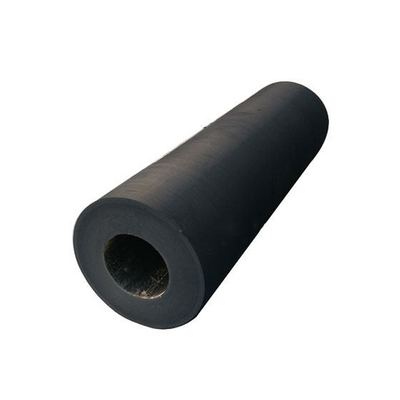
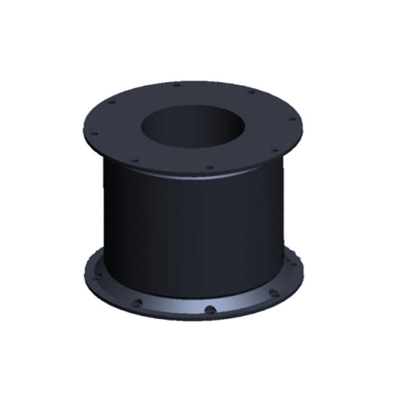
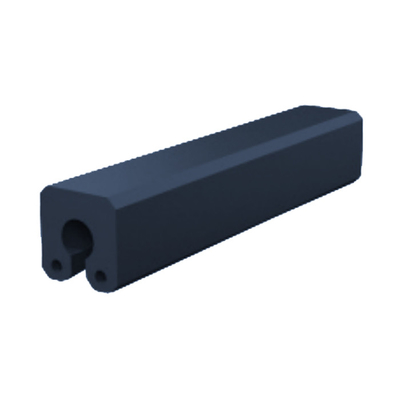
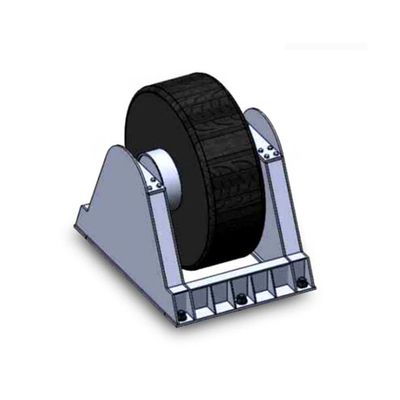
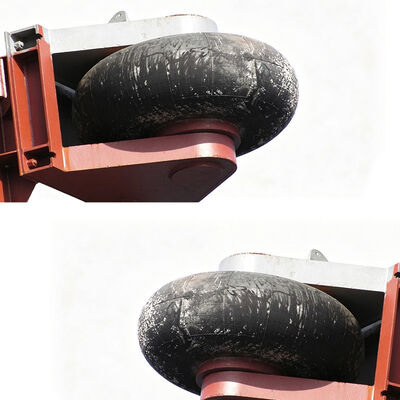
Roller Fenders are engineered marine protection assemblies designed to control vessel contact forces while allowing the contacting vessel to move along the fender surface with reduced sliding resistance. Unlike conventional fixed rubber fender profiles that primarily rely on compression and deformation, a Roller Fender incorporates a rotating cylindrical rubber body supported by a central shaft, bearing or bushing arrangement, steel frame, and structural mounting components.
This operating principle is particularly useful where vessels cannot approach a berth, guide wall, lock entrance, or dock structure along a perfectly perpendicular trajectory. In these conditions, a fixed contact surface can experience substantial friction, localized abrasion, and repeated lateral loading. A rotating roller provides a continuously moving contact interface, helping the vessel travel along the protected structure while distributing the interaction over the length of the rubber body.
A commercial port in the Middle East required an upgraded vessel guidance system along a high-traffic approach structure connecting the outer harbor with an inner cargo handling area. The facility was used by bulk carriers, general cargo vessels, and service vessels, with vessel sizes varying considerably according to the operating schedule.
The original protection arrangement relied on fixed rubber contact elements installed along sections of the guide wall. During vessel approach and alignment, ships could make contact at an angle rather than directly perpendicular to the wall. As the hull moved forward, the fixed rubber surfaces were subjected to sliding contact, generating repeated friction and localized wear.
The replacement system was designed around heavy-duty Roller Fenders with reinforced steel support assemblies. The project engineering team reviewed vessel dimensions, estimated contact locations, operating directions, water level conditions, and the available structural fixing points before establishing the roller arrangement.
Following commissioning, vessels were able to maintain contact with the rollers while continuing their forward movement along the guide wall. Instead of forcing the rubber surface to remain stationary against the moving hull, the rollers rotated with the direction of vessel movement, reducing sliding interaction and distributing repeated contact over the roller circumference.
| Product Name | Roller Fenders |
| Material | High Density NR/NBR/SBR |
| Temperature | from -30°C to 70°C |
| Specific Gravity | 1.45 g/cm³ |
| Intensity | 3 MPA |
| Hardness | 65 ± 5 Shore A |
| Elongation | ≥300% |
| Size | D1080-2900mm |
| Package | By Pallets, By carton, By Iron Cage |
| Color | Black, as Required |
| Certificate | CE, ROHS, REACH, SGS, MSDS, ISO9001 |
| Experience | 32 years |
| Market | North America, Asia, Europe, South America, Australia, Africa |
| Payment | BANK TRANSFER, 30% T/T, Balance Before Shipment, L/C |
| Model No. | A [mm] | B [mm] | C [mm] | D [mm] | E [mm] | G [mm] | H [mm] | J [mm] | K [mm] | L [mm] |
|---|---|---|---|---|---|---|---|---|---|---|
| HM-RF1080 | 1250 | 1150 | 610 | 1080 | 1150 | 220 | 460 | 800 | 340 | 60 |
| HM-RF1450 | 1530 | 1400 | 740 | 1320 | 1450 | 260 | 510 | 950 | 400 | 75 |
| HM-RF1500 | 1600 | 1450 | 765 | 1370 | 1500 | 270 | 610 | 1000 | 425 | 75 |
| HM-RF1900 | 2050 | 1850 | 975 | 1750 | 1900 | 350 | 690 | 1250 | 500 | 125 |
| HM-RF2100 | 2300 | 2100 | 1110 | 1980 | 2100 | 400 | 765 | 1400 | 550 | 150 |
| HM-RF2700 | 3000 | 2700 | 1425 | 2550 | 2700 | 500 | 895 | 1800 | 700 | 200 |