Floating Pneumatic Rubber Fender — Self-Floating, Easy Installation, Anti-Collision Protection for Ship Berthing
Yokohama Rubber Fender is an inflatable marine protection system developed for vessel berthing, ship-to-ship operations, and other applications requiring controlled impact absorption. Its pneumatic construction uses compressed air as the cushioning medium, allowing the fender to deform under external loads and distribute contact pressure across the rubber body. This operating principle helps reduce impact forces transferred between vessels or between vessels and suitable marine structures.
The product is generally manufactured using high-strength synthetic-cord-reinforced rubber. Its construction consists of an inner rubber layer, reinforcement layers, and an outer protective rubber layer. The inner layer provides air retention, the reinforcement structure contributes tensile strength and dimensional stability, and the external rubber layer protects the body against abrasion, environmental exposure, and mechanical damage.
The reinforcement arrangement is particularly important because the fender must maintain its structural integrity under internal inflation pressure and repeated external compression. Rubber compound selection, cord adhesion, layer bonding, and vulcanization quality all influence the finished product's performance and service reliability.
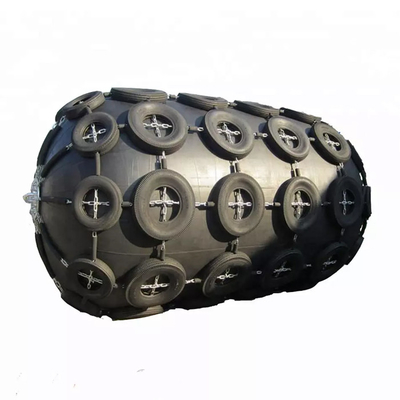
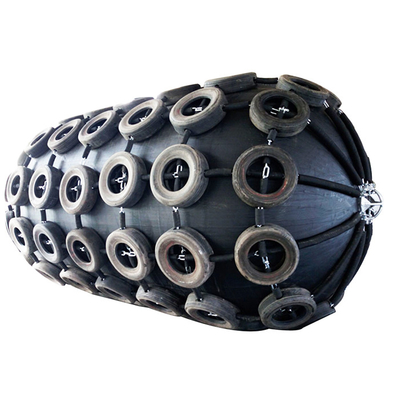
Yokohama Rubber Fenders are available in different diameters, lengths, pressure ratings, and connection configurations. Depending on the application, they can be supplied with a sling arrangement or an external protective tire-chain net. The net-type configuration provides additional protection against direct contact and abrasion, while the sling-type configuration offers a different handling and installation arrangement.
During operation, the compressed air inside the fender provides cushioning when the vessel makes contact. As the rubber body compresses, the internal air pressure changes and the structure develops a reaction force. The relationship between energy absorption and reaction force is a key consideration in selecting a suitable fender model. These performance values must be evaluated according to the specified dimensions, initial internal pressure, compression ratio, and applicable testing conditions.
The product is suitable for marine environments where flexible contact protection is required. Its inflatable structure can accommodate certain variations in contact position and vessel movement, making it useful for ship-to-ship berthing, floating platforms, port terminals, and offshore support activities.
Compared with rigid protection systems, pneumatic fenders offer flexibility in handling, positioning, and configuration. They can be selected according to specific project requirements and reused when their condition and maintenance status remain acceptable. Proper inflation management, regular inspection, and appropriate storage are essential to maintaining long-term operational reliability.
Case Study: Temporary Fendering for a 50,000 DWT Tanker
A major port development project in the Middle East required a temporary fendering system for a 50,000 DWT product tanker during berthing trials and marine equipment commissioning. The vessel needed to operate alongside a floating service platform while technicians completed equipment installation and functional testing.
The project team identified several challenges. The relative movement between the tanker and floating platform could change with wind, tidal conditions, and loading operations. The existing protection arrangement also provided limited adaptability when the vessel's contact position changed. The port operator therefore required a flexible fendering solution that could accommodate different contact conditions without requiring permanent modifications to the platform.
Hongruntong Marine reviewed the vessel information, platform arrangement, expected operating conditions, and available installation locations. Based on the technical requirements, a suitable Yokohama Rubber Fender configuration was proposed. The selection considered the required dimensions, energy absorption performance, reaction force, protective arrangement, and connection method.
The supplied fenders were positioned at designated contact areas along the floating platform. Before commissioning, the project team inspected the rubber surfaces, reinforcement condition where accessible, external protective components, connecting hardware, and inflation pressure. Installation positions were also checked to ensure that the fenders could operate without interference from platform structures.
During berthing trials, the pneumatic fenders provided a flexible contact interface between the tanker and the floating platform. Their deformation characteristics helped accommodate changes in contact conditions and reduced the likelihood of direct contact between rigid structural components. The adjustable arrangement also allowed the port team to modify the fender positions during different commissioning stages.
Following the initial operation, the fenders were inspected and prepared for subsequent use. The port operator retained the equipment for additional vessel-support activities, reducing the need to procure separate temporary protection equipment for each operation.
The project demonstrated how pneumatic fender systems can support marine commissioning and temporary berthing operations when properly selected and installed. The customer also emphasized the importance of confirming pressure requirements, connection details, and inspection procedures before deployment.
The same engineering approach can be applied to other port and offshore projects, provided that vessel characteristics, environmental conditions, and allowable reaction forces are evaluated individually.
Specifications
| Place of Origin |
China |
| Brand Name |
Yokohama Rubber Fender |
| Material |
Natural Rubber |
| Color |
Black |
| Application |
Ports with extreme tidal variations; ship-to-ship lightering operations; oil & gas (typically FSRU); temporary berthing |
| Feature |
Heat Resistance |
| Sample |
Usually free |
| Production Method |
Moulding |
| Temperature |
-40℃ ~ 300℃ |
| Packing |
Pallets |
| Lead Time |
7–14 days |
Performance Data by Size and Initial Pressure
Diameter × Length
[mm] |
50 kPa Performance Data |
80 kPa Performance Data |
Hull Pressure at GEA
/ kN/m² |
Reaction Force
/ kN |
Energy Absorption
/ kNm |
Hull Pressure at GEA
/ kN/m² |
Reaction Force
/ kN |
Energy Absorption
/ kNm |
| 1000 × 1500 |
122 |
182 |
32 |
160 |
239 |
45 |
| 1000 × 2000 |
132 |
257 |
45 |
174 |
338 |
63 |
| 1200 × 2000 |
126 |
297 |
63 |
166 |
390 |
88 |
| 1350 × 2500 |
130 |
427 |
102 |
170 |
561 |
142 |
| 1500 × 3000 |
153 |
579 |
153 |
174 |
761 |
214 |
| 1700 × 3000 |
128 |
639 |
191 |
168 |
840 |
267 |
| 2000 × 3500 |
128 |
875 |
308 |
168 |
1150 |
430 |
| 2500 × 4000 |
137 |
1381 |
663 |
180 |
1815 |
925 |
| 2500 × 5500 |
148 |
2019 |
943 |
195 |
2653 |
1317 |
| 3300 × 4500 |
130 |
1884 |
1175 |
171 |
2476 |
1640 |
| 3300 × 6500 |
146 |
3015 |
1814 |
191 |
3961 |
2532 |
| 3300 × 10600 |
158 |
5257 |
3067 |
208 |
6907 |
4281 |
| 4500 × 9000 |
146 |
5747 |
4752 |
192 |
7551 |
6633 |
Other sizes can be produced according to client requirements.
Features
Multi-Layer Rubber Construction and Structural Integrity
Yokohama Rubber Fender adopts a multi-layer construction designed to combine air retention, reinforcement strength, and external protection. The inner rubber layer functions as an air-retaining barrier, helping maintain the required internal pressure during operation. Its material properties and manufacturing quality directly influence the fender's ability to maintain stable inflation conditions.
The intermediate reinforcement layers are generally made from high-strength synthetic cord fabric. These layers are arranged to provide tensile resistance and control dimensional deformation under internal pressure. Their structural contribution is particularly important for large-diameter fenders because the rubber body must withstand considerable internal stress while maintaining its designed shape.
The outer rubber layer protects the internal construction from direct exposure to seawater, sunlight, abrasion, and normal handling damage. It also provides the external contact surface during vessel berthing. Appropriate rubber formulation helps balance flexibility, wear resistance, and mechanical strength.
The bonding between different layers is another important manufacturing consideration. Poor adhesion or inconsistent vulcanization may lead to separation between rubber and reinforcement, potentially affecting the fender's structural reliability. Therefore, material preparation, layer arrangement, bonding procedures, and process control should be treated as essential quality considerations throughout production.
Synthetic Cord Reinforcement and Pressure Resistance
The reinforcement structure is responsible for supporting the fender under internal air pressure and external operating loads. High-strength synthetic cord materials are used to provide tensile resistance while allowing the inflatable body to maintain its designed geometry.
During inflation, the rubber body experiences internal pressure that produces stress throughout its structure. When external compression occurs, the load distribution changes and the fender deforms to absorb berthing energy. The reinforcement layers help control this deformation and reduce excessive dimensional changes.
The performance of the reinforcement depends on cord material properties, fabric arrangement, layer quantity, adhesion to rubber, and manufacturing consistency. These factors must be considered together rather than evaluating the reinforcement material independently.
For larger fender specifications, structural design and pressure requirements become especially important. The selected product should be verified against the required operating pressure, dimensions, and performance criteria. Pressure testing and relevant inspection procedures provide important information about the condition of the completed fender before delivery.
Pneumatic Cushioning and Energy Absorption Characteristics
The pneumatic operating principle distinguishes Yokohama Rubber Fenders from many solid rubber protection systems. The internal compressed air provides a cushioning medium that responds to external compression. As the fender is compressed during berthing, its internal volume decreases and the air pressure increases, producing a reaction force while absorbing part of the impact energy.
Energy absorption and reaction force must be considered together during engineering selection. A fender with an appropriate energy absorption capacity must also maintain reaction force within the allowable limits of the vessel and supporting structure.
Performance characteristics are influenced by diameter, length, initial pressure, compression ratio, and operating temperature. Therefore, nominal dimensions alone are insufficient for determining whether a fender is suitable for a particular vessel.
For demanding marine projects, the selection process should include vessel displacement, berthing velocity, approach angle, tidal conditions, and the arrangement of multiple fenders. Model-specific performance curves and technical documentation should be reviewed before final approval.
This pneumatic cushioning principle provides flexibility for operations involving vessel movement and changing contact conditions. It is particularly valuable in ship-to-ship transfer, floating terminal, and offshore support applications where rigid contact protection may not provide the required adaptability.
Protective Surface Design and Long-Term Maintenance
The outer rubber surface is exposed to environmental and mechanical influences throughout the product's service life. Contact with vessel structures, marine equipment, and floating objects may produce abrasion, localized pressure, or surface damage. The protective rubber layer is therefore designed to provide a durable external barrier around the reinforced body.
For net-type fenders, an external tire-chain arrangement can provide additional protection. The tires act as replaceable contact elements, helping reduce direct abrasion of the main rubber body. Chains, shackles, and connecting rings maintain the protective assembly and support handling arrangements.
Maintenance requirements vary according to installation conditions, usage frequency, and environmental exposure. Routine inspections should include external rubber condition, inflation pressure, visible reinforcement damage, protective net integrity, and metal fitting condition. Any unusual deformation, leakage, cuts, or damaged connecting components should be evaluated before the next operation.
Proper storage is also important when fenders are temporarily removed from service. They should be cleaned, inspected, protected from unsuitable environmental exposure, and stored according to manufacturer recommendations. These procedures help preserve the condition of the rubber and associated accessories and support repeated use in suitable marine projects.
Applications
Oil and Gas Terminals
Yokohama Rubber Fenders are used in suitable oil and gas terminal operations where vessels require flexible berthing protection. Their pneumatic construction provides a cushioning interface during vessel approach and contact. Depending on the terminal arrangement, they can support tanker berthing, floating terminal operations, and ship-to-ship transfer. Selection should consider vessel displacement, transfer conditions, hazardous-area requirements, and applicable terminal engineering standards.
Floating Production and Offshore Support Facilities
Offshore facilities often operate under changing environmental conditions, including waves, wind, and variations in vessel positioning. Pneumatic fenders can be installed between support vessels and suitable floating structures to accommodate relative movement and reduce direct impact. Their dimensions, connection arrangements, and performance characteristics should be evaluated according to the offshore operating environment.
Shipbuilding and Vessel Maintenance Projects
Shipyards use Yokohama Rubber Fenders during vessel repair, maintenance, outfitting, and floating-dock operations. Their flexible positioning allows shipyard personnel to adjust protection arrangements according to vessel dimensions and work requirements. With proper inspection and storage, the equipment can be reused across multiple suitable projects, supporting more efficient equipment management.
Why Choose Hongruntong Marine
Established Manufacturing Experience and Marine Product Knowledge
Hongruntong Marine has more than 30 years of manufacturing experience in marine and industrial products. This experience provides a foundation for understanding the technical requirements of marine rubber products, including material selection, structural design, production control, and product inspection.
Yokohama Rubber Fenders involve several interconnected manufacturing processes. Rubber formulation must be compatible with reinforcement materials, while layer bonding and vulcanization must be controlled to support structural integrity. Product dimensions and internal construction must also remain consistent with the approved technical specifications.
Our manufacturing experience supports communication with customers who require standard products as well as project-specific configurations. We understand that different marine applications may require different dimensions, pressure ratings, protective arrangements, and connection details.
For overseas procurement projects, clear technical communication is essential. Our team can review customer drawings, product specifications, and operating requirements to help establish a clear basis for quotation and production confirmation.
Technical Configuration Based on Project Requirements
Selecting a pneumatic fender requires more than matching a diameter and length. The engineering process should consider the vessel's displacement, berthing velocity, required energy absorption, allowable reaction force, installation position, and environmental conditions.
Hongruntong Marine supports technical discussions to clarify these factors before product configuration is finalized. Customers can provide vessel details, existing fender specifications, engineering drawings, or project documents. Based on the available information, the required product dimensions, protective net arrangement, accessories, and connection details can be reviewed.
Different projects may require sling-type or net-type arrangements, depending on handling methods and operational conditions. Customization can also involve dimensions and associated hardware, subject to technical feasibility and confirmed manufacturing specifications.
This project-oriented approach helps reduce specification misunderstandings and provides a clearer basis for product approval. It is particularly useful for port construction, offshore support, shipyard maintenance, and international marine equipment procurement.
Material Management and Production Process Control
The quality of a pneumatic rubber fender depends on the interaction between rubber materials, reinforcement fabrics, and manufacturing processes. Hongruntong Marine emphasizes appropriate material selection and process management to support the consistency of finished products.
The inner rubber layer must provide suitable air-retaining properties. Reinforcement materials must offer the required tensile performance and maintain reliable bonding with surrounding rubber layers. The external rubber compound must provide appropriate flexibility and resistance to normal marine operating conditions.
Production control also involves the preparation of rubber materials, reinforcement placement, forming, vulcanization, and final product inspection. Each stage contributes to the finished structure and should follow the confirmed manufacturing requirements.
Quality inspection may include dimensional verification, visual examination, pressure-related checks, and other tests specified for the product model or order. Inspection scope and supporting documents can be agreed with customers before production to ensure that the supply requirements are clearly defined.
International Project Coordination and Technical Support
Marine equipment procurement often involves several parties, including shipowners, shipyards, engineering contractors, distributors, and inspection organizations. Coordination between these parties is important to ensure that product specifications, manufacturing arrangements, and delivery requirements remain consistent.
Hongruntong Marine supports customers during product inquiry, technical clarification, quotation preparation, production coordination, and shipment arrangements. For customized orders, drawings and technical details can be reviewed before production to reduce the possibility of discrepancies.
After delivery, customers can receive relevant product information and guidance concerning inflation pressure, handling, inspection, maintenance, and storage. Where technical issues arise, clear product specifications and inspection records help support communication and evaluation.
Our objective is to provide marine equipment supply based on practical manufacturing experience, confirmed technical requirements, and consistent communication. This approach supports long-term cooperation with international customers seeking dependable marine rubber fender solutions.
Frequently Asked Questions
1. What is the difference between a sling-type and a net-type Yokohama Rubber Fender?
A sling-type fender is designed for handling and installation using designated lifting and suspension arrangements. A net-type fender includes an external protective assembly, commonly using tires and connecting chains, to provide additional protection against abrasion and contact damage. The appropriate configuration depends on the project requirements.
2. How does the reinforcement structure affect fender performance?
Synthetic cord reinforcement provides tensile strength and helps maintain dimensional stability under internal pressure and external compression. Reinforcement material, layer arrangement, and rubber adhesion all influence structural reliability.
3. Does internal pressure affect energy absorption and reaction force?
Yes. Initial internal pressure is an important factor influencing the fender's performance. Energy absorption and reaction force must be evaluated using the relevant technical data for the selected model and specified compression conditions.
4. Can pneumatic fenders be used in offshore environments?
Yes, provided that the selected model, materials, connection arrangements, and installation method are suitable for the offshore operating conditions. Wave movement, vessel characteristics, environmental exposure, and project-specific safety requirements should be considered.
5. How should Yokohama Rubber Fenders be stored when not in use?
Fenders should be cleaned and inspected before storage. They should be kept in a suitable environment away from sharp objects, excessive heat, and damaging chemical exposure. Internal pressure and storage conditions should follow the manufacturer's recommendations.


 Your message must be between 20-3,000 characters!